Niche Intelligence

Stop guessing.
Pick with
data.

Nichint pulls verified revenue data from 4,800+ startups, runs structural analysis across a niche, and uses AI to surface exactly where the opportunity is — before you write a line of code.

Free tier available · No credit card required

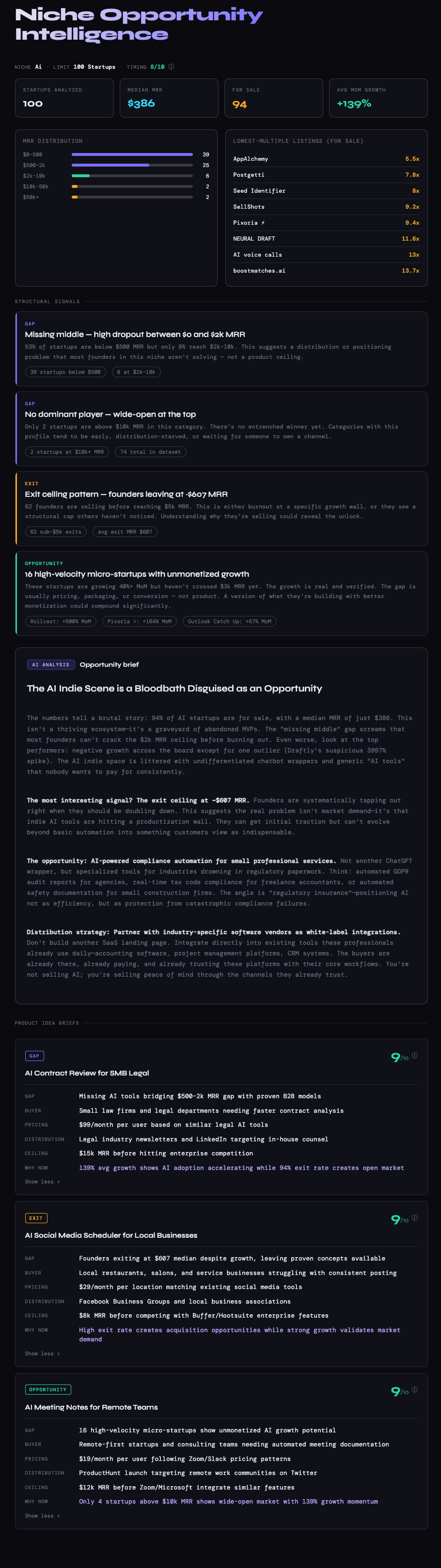
Nichint app screenshot
Click to expand ↗
Process

THREE STEPS.
ONE DECISION.

From raw verified data to an actionable product brief — in under 30 seconds.

01
Pick a niche & configure

Choose from 30+ categories. Filter by MRR range, growth floor, sale status. Set the exact lens you want to analyze through.

02
Structural analysis runs

Nichint fetches up to 100 verified startups from TrustMRR and detects gap patterns, exit ceilings, underpriced exits, and high-velocity movers in seconds.

03
AI surfaces the opportunity

Claude reads the structural signals and produces a sharp, opinionated brief: niche maturity read, the strongest gap, a concrete product idea, and the distribution angle to make it work.

FOUR SIGNALS.
ALL
STRUCTURAL.

Nichint doesn't look at one startup and ask "is this doing well?" It looks at 100 of them together and asks what the shape of the distribution reveals about the forces operating in that niche.

GAP
The missing middle

When startups cluster at low MRR and few make it past $2k, there's a wall in the niche. Usually a distribution problem nobody has solved — which means the first person who figures it out has a structural advantage.

GAP
No dominant player

Fewer than 3 startups above $10k MRR means the niche hasn't produced a winner yet. Either very early timing, or a structurally low ceiling. The surrounding signals tell you which.

EXIT
Exit ceiling pattern

When multiple unrelated founders all sell at the same low revenue level, something structural is killing momentum at that point. Understanding the wall is more valuable than acquiring the startup.

DEAL
Underpriced exits

Listings below 2x MRR signal distribution-limited assets, not product-limited ones. Treat them as free product research — what did they build, what ceiling did they hit, how would you build v2 differently?

OPP
High-velocity micro-startups

Growing 40%+ MoM but still under $3k MRR. The growth is verified Stripe data. The gap is almost always pricing or packaging. A version with better monetization compounds significantly.

Pricing

FLAT RATE.
NO METERING.

Metered pricing creates anxiety at exactly the moment you want to explore freely. Nichint is flat monthly — scan as much as you need.

Free
$0/month

Enough to feel the signal. Not enough to act on it seriously.

  • 2 scans per month
  • Narrative opportunity brief
  • Structural signal cards
  • Product idea briefs
  • Timing score
  • Advanced filters
  • Watchlists
Start free
Builder
$49/month

For founders actively running multiple product bets simultaneously.

  • Everything in Solo
  • Unlimited watchlists
  • Competitor gap mapper
  • Category vs category comparison
  • Momentum tracker
  • Webhook + Telegram delivery
Get Builder

⚡ Lifetime deal — $79 for the first 100 users.
Full Solo-tier access, forever. No recurring charges. After 100 users this offer disappears permanently.

Questions

FAQ

Where does the revenue data come from?

TrustMRR — a verified startup revenue database that connects directly to founders' Stripe, LemonSqueezy, RevenueCat, and Paddle accounts. The data is tamper-proof and updated hourly. Nichint queries the TrustMRR API for each scan.

Is this the same as a trend tool like Exploding Topics?

No. Trend tools surface rising search interest. Nichint surfaces verified revenue patterns — what's actually making money, what's plateauing, what's being abandoned, and what the shape of all of it together reveals about the niche. It's product intelligence, not content intelligence.

What is a structural signal?

A pattern in the distribution of an entire market's data — not what one startup is doing, but what the arrangement of 50–100 of them reveals about the forces operating in the niche. Exit ceilings, missing middles, and underpriced exits are all structural signals.

What is the timing score?

A 1–10 score that estimates how well-timed it is to enter a niche right now. It weighs three signals: average MoM growth across the category (is momentum building?), how many startups have reached $10k+ MRR (is there an entrenched winner yet?), and the exit ratio (are founders bailing, which could signal a structural ceiling — or a buying opportunity). A score of 7+ generally means the niche is growing fast with no dominant player and some distress in the market — the ideal window to enter.
Ready?

Pick your next
niche with
certainty.

Three scans free. No credit card. Results in 30 seconds.

Run your first scan